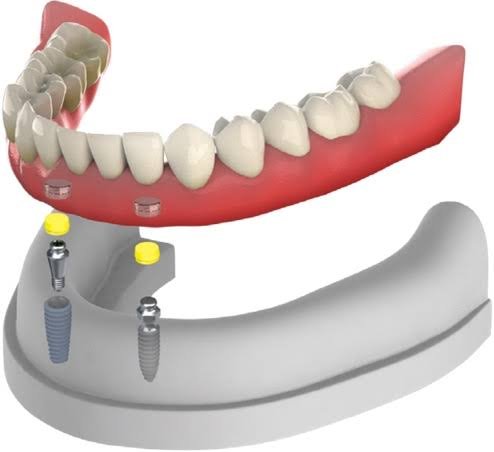
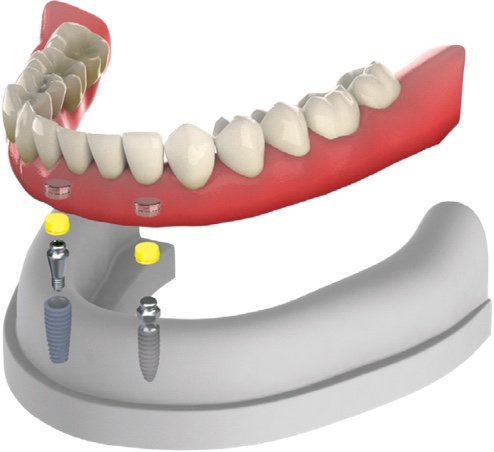
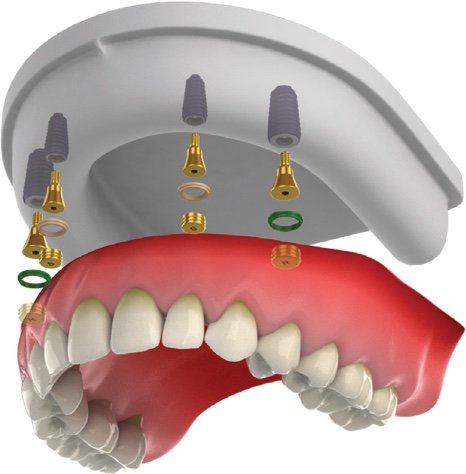
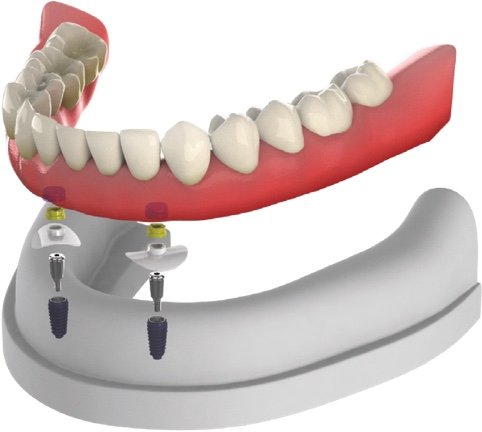
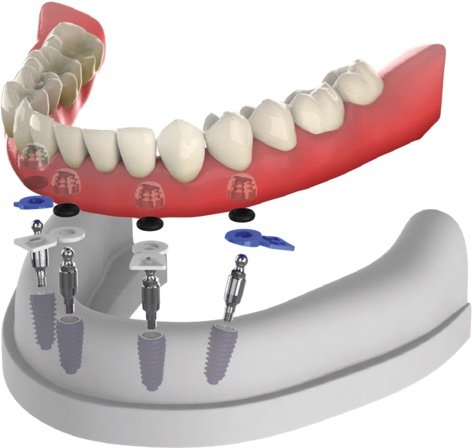
The denture, attachment components, and implants work together. Your upper and lower jaw are assessed separately to plan the support your restoration needs.
01 / Lower arch
A steadier foundation for a loose lower denture.
Explore whether implant retention could improve the stability of your lower denture. We assess the ridge, bite, and denture before recommending conversion or a new restoration.
02 / Upper arch
Designed around your upper jaw.
The upper arch needs its own evaluation of bone, support, restorative space, and denture design. We explain the proposed implant arrangement and attachment system before treatment.
Manufacturer illustrations show example configurations. The number of implants, attachment type, and denture design are determined individually; the pictures are not a treatment prescription.
Already wearing a complete denture?
Keep the smile. Explore added retention.
Your existing denture may be suitable for adaptation to implant attachments. If it is worn, poorly fitting, or lacks the necessary space, a new denture may be the better plan.
Review your health, anatomy, current denture, and goals.
02
Implants & healing
Discuss preparation, implant placement, and the healing and provisional plan for your case.
03
Connect & fine-tune
Fit the planned attachments, adjust the denture, and practice insertion and removal.
04
Maintain & review
Clean daily and return for checks of the tissues, bite, denture, and attachment wear.
Explore MegaGen’s attachment family
Small components. A purposeful connection.
See the different attachment approaches in MegaGen’s overdenture range. Your clinician will explain which system is appropriate and available for your treatment.
01Retention inserts
Meg-Loc
An attachment system with replaceable inserts offering different retention levels.
What this means for you +
Your clinician selects the attachment and insert for your restoration. Inserts need review as they wear.
02Ball attachment
Meg-Ball
A ball-shaped connection with a compact housing and retentive ring.
What this means for you +
The attachment must work with the available restorative space and implant positions.
03Magnetic connection
Meg-Magnet
A magnetic attachment designed to help the denture seat onto its supporting components.
What this means for you +
Cleaning access and the ability to insert and remove the denture are part of the discussion.
04Retentive cap system
Meg-Rhein
An attachment family with a range of retentive caps and options for implant angulation.
What this means for you +
The cap and housing are selected for the treatment plan; maintenance remains part of care.
Product information and illustrations: MegaGen. System selection and component compatibility require clinical assessment.
The complete restoration
The implant. The attachment. Your removable smile.
01 / FOUNDATION
The implants
Implants provide anchorage in the jaw. Their placement and healing are coordinated with the planned restoration.
02 / CONNECTION
The attachments
Components connect the denture to the implants. They are checked during maintenance and may need replacement as they wear.
03 / EVERYDAY CARE
The overdenture
You remove it for cleaning. The fit, bite, and supporting tissues still need professional review over time.
Choose with clarity
Removable or fixed? Understand the difference.
Your restoration
Conventional denture
Snap-on overdenture
Fixed full arch
Connection
Rests on the gums; no implants
Retained by implant attachments
Secured to implants
Daily removal
Removed by you
Removed by you
Removed by the dental team when needed
Ongoing care
Denture and gum cleaning; fit reviews
Denture, implant, and attachment cleaning; wear reviews
Cleaning beneath and around the restoration; professional maintenance
Each option has different treatment, maintenance, and cost considerations. Your evaluation guides the recommendation.
Options that fit your life
Flexible ways to pay.
Explore payment options with Cherry, Sunbit, and CareCredit, along with eligible American Express® perks. Review current terms and check eligibility directly through each provider.
Financing is subject to provider approval. Terms and availability are determined by each financing provider.
Advanced imaging at Icónica
Vatech CBCT. CleverOne clarity.
Icónica uses Vatech cone-beam computed tomography (CBCT) with CleverOne software to support diagnosis and the planning of surgical and dental implant procedures. When clinically indicated, three-dimensional imaging helps us assess tooth roots, available bone, and nearby structures such as nerves and sinuses.
CleverOne supports image review and visual treatment planning, helping us explain your anatomy and proposed care more clearly. For implant treatment, this information supports assessment of the site and planning of implant position.
Imaging is selected for your individual needs. CBCT is used when the additional three-dimensional information is clinically appropriate; it is not required for every examination or procedure.
Your questions, answered
Clarity before the next step.
Learn about implant-supported dentures, planning, care, and payment.
Planning & your options
Is this a removable denture?
The snap-in denture described here is removable by you for cleaning. Other implant-supported restorations are fixed; we explain which design is being proposed.
How does it differ from a traditional denture?
Implant attachments add retention and may improve stability. The benefit and level of tissue support depend on the design and your anatomy.
How is it different from All-on-X?
All-on-X describes a fixed full-arch implant restoration. A removable implant-retained denture is taken out by the patient and uses a different attachment and maintenance approach.
How many implants will I need?
The number is planned individually according to the upper or lower arch, available bone, loading, and restoration design. There is no single number suitable for every case.
Can my current denture be adapted?
Sometimes, if its fit, condition, design, and available space are suitable. Otherwise a new denture may be recommended.
Treatment & ongoing care
What if I have bone loss?
Imaging and examination determine what support is available. Grafting or another treatment approach may be considered; bone loss does not lead to one universal solution.
How long does treatment take?
Treatment is often staged around preparation, implant placement, healing, and the final denture. We explain the provisional plan and likely timing for your case.
How do I clean around the implants?
Use the tools and technique recommended for your attachments, as well as cleaning the removable denture. Regular professional reviews are still needed.
Will attachments need replacement?
Attachment components can wear. Replacement intervals vary with the system and use, and the denture itself may need adjustments, relining, or replacement.
Am I a candidate?
We assess bone, oral hygiene, health, medications, smoking, the bite, and treatment goals. The consultation helps determine whether this or another option is appropriate.
Costs & payment
How much will my treatment cost?
Your estimate depends on the findings, treatment design, complexity, and any supporting care. We review the planned fees and inclusions before you proceed.
Will my insurance cover care?
Benefits vary by plan, exclusions, limits, and the reason for treatment. Our team can help review the estimated benefits and patient portion. An estimate does not guarantee insurer payment.
Do you offer financing?
Icónica offers access to Cherry, Sunbit, and CareCredit. Approval, rates, offers, and repayment terms vary by provider and applicant.
Icónica Dental Group · Hallandale Beach
Let’s talk about a more confident fit.
Bring your current denture and your questions. We’ll help you understand whether conversion or a new implant-retained denture is appropriate.
Product imagery and attachment-system reference: MegaGen Overdenture Systems. MegaGen product names belong to their respective owners. Illustrations are educational; treatment suitability and outcomes vary.